
News
- February 2014
- A Lunch with Mavis
- December 2013
- Award Season
- November 2013
- Harper's Magazine and The Wall Street Journal
- September 2013
- Interviews and Reviews
- August 2013
- Live on NBC's 'Morning Joe'
- Excerpts and Other Reading Material
- Book Launch!
- July 2013
- Charting
- An Excerpt
- The Trades Are Glowing
- Dreaming of Forever
- June 2013
- The Wylie Agency
- Limited Edition Octopus Print
- November 2012
- On The Big Screen
- Fruit Hunters on Dr. Oz
- China, Japan, Korea
- February 2011
- A Few Recent Stories
- Wall Street Jam
- Tomatoes and Kids
- Travel and Leisure
- October 2009
- "The Very Noble Train of the Huntsman"
- CBC Book Club And Other News
- September 2009
- Goblin Market
- A Bumper Crop...
- Turning Japanese
- August 2009
- The Children of Light - Photos!
- Get Fruity
- The Eternal Ones of the Dream
- June 2009
- UK Fruit Media Blitz
- May 2009
- Fruits of Desire
- The Fruit Hunters UK... and other editions out now!
- April 2009
- Newsflash: The Center of the Galaxy Tastes Like Raspberries
- Systems of Delayed Orgasms...
- Obsession Lesson
- March 2009
- More Mega-Fruit Coverage
- January 2009
- Reading Matter
- Upcoming Engagements
- Miracle Fruit Frenzy Continues!
- October 2008
- Shortlisted 2x, Readings...
- Fruit Club!
- Morphology, Purple Flowers
- Audio Book
- Interviews, etc
- July 2008
- Maslin Picks Fruit!
- Montreal Miracle Fruit Party
- Fruity Freakies
- June 2008
- Montreal Launch
- May 2008
- New York Times Hearts Fruit Hunters
- Canadian Tour
- Jerusalem In My Heart
- West Coast
- A New Fruit Hunter Blog
- Q&A
- Utne Reader on Orion Excerpt
- Pre-Publication Fruit Hype
- “Baby, Let’s Make Fruit Salad”
- April 2008
- Fruit Tour
- The City is Blue
- The Trades Are Glowing
-
A Lunch with Mavis
Feb 20, 2014Imagine Paradise: Remembering Mavis Gallant
The Paris ReviewMavis Gallant was a family friend of ours. My mother knew her well. I remember her visits when I was a child: she was so intelligent, wry, and observant—so funny and so cool, with her Parisian air of detachment. She was fascinated with my platinum-haired younger brother, Julian, whom she deemed a “changeling.”
While passing through Paris in my late twenties, at work on my book The Fruit Hunters, I once stopped in to bring her a letter from my mother and some flowers. Not wanting to interrupt her writing, I suggested coffee or a glass of wine. She insisted we meet at Le Dome for lunch.
I arrived five minutes early, left her bouquet on the table, and went out to pick up a Herald Tribune. Workers were marching in the streets as part of a general manifestation against the government. By the time I returned, she was sitting there, beaming. She waved at the protesters, she whose May 1968 diary for The New Yorker concluded, “I am convinced that I have seen something remarkable.”
We had oysters. She chose Cancales, which she said were the tsars’ favorites. The oysters arrived shucked, but still attached to their bottom adductor muscle. “The difference between France and North America,” she explained, as though letting me in on a highly confidential secret, “is that the French like their oysters living and North Americans like their oysters dead.”We spoke about writing, and living, and Montreal, which she left as a twenty-eight-year-old reporter to become a writer of short fiction in Paris. She didn’t like being around other writers, she confided, but she’d make an exception for me. I protested that I wasn’t yet a writer, that I wasn’t even sure I’d be able to finish a book. She spoke with acceptance, and some sadness, of the Dreyfus book she’d toiled on for years before finally shelving it. “I still have a thousand pages of it sitting in a linen closet, underneath my towels,” she said, looking up in resignation.
I thought of that indelible scene in The Other Paris, the one where a chunk of plaster bearing the foot of a nymph detaches itself from the theater ceiling and crashes to the floor.
Mavis seemed genuinely curious about my quest for fruits. I was en route to the Seychelles, once thought to be the literal site of the Garden of Eden. She spoke of how wonderful it would be if paradise turned out to be real, if we could taste its fruits in this lifetime. “Imagine?” she said. We both did so for a moment, and I wished I could see what she was seeing.
When we parted, on the boulevard du Montparnasse, I leaned over to give her a kiss on the cheek. “If you do find paradise,” she said, turning to leave, “send me a grape.”
She’ll be missed and mourned by all of us who knew and loved her, as well as those who admire her stories. Whether or not paradise exists, may you rest in peace, Mavis.
-
Award Season
Dec 15, 2013The Book of Immortality just won the Mavis Gallant Prize for Non-Fiction at the QWF Awards:
http://www.montrealgazette.com/news/Nawaz+Gollner+take+honours/9186963/story.html“This is at once a big, ambitious, high-concept book and an intellectual romp,” the jury cited. “Intelligent and well-researched, it is accessible, anecdotal and entertaining. Saucy, smart, scholarly and wide-ranging.”
And it is also nominated for the BC National Non-Fiction Award:
http://www.bcachievement.com/nonfiction/longlist.phpPhoto from the Montreal Gazette:

-
Harper's Magazine and The Wall Street Journal
Nov 05, 2013The November issue of Harper’s Magazine contains an essay length book review by Bee Wilson which calls The Book of Immortality a “wonderful exploration… a picaresque in various subcultures of life extension that is openhearted but not credulous, sardonic but not cynical.” Read the full story here
*Mid-Nov Update: The fall issue of the Montreal Review of Books features a cover story on The Book of Immortality

And The Wall Street Journal also ran an excellent review of The Book of Immortality (behind a paywall).
“Highly enjoyable,” they say. “Exquisite moments of offbeat comedy… Mr. Gollner is a fine wordsmith. Part Mary Roach, part Joe Strummer of the Clash, he injects punk energy and invention into the genre of quirky scientific nonfiction. Long may he write.”As an aside, I was delighted to note that the reviewer was Dr. John J. Ross, M.D., author of “Shakespeare’s Tremor and Orwell’s Cough: The Medical Lives of Great Writers.” It was in his book that I learned about how Milton was treated with “usnea“—“moss from the skull of a man who had died violently (in plentiful supply in a damp country where there was an abundance of severed heads rotting on pikes),” as the WSJ put it in their review of his book.
May the circle remain unbroken. The full review:
DON’T FEAR THE REAPER
The Book of Immortality, by Adam Leith GollnerSpoiler alert: We are all going to die. With a lean diet, regular exercise, stimulating work, strong friendships, good genes and a generous dollop of luck, some of us may live longer than others, but we are all mortal. Thus the title of Adam Leith Gollner’s highly enjoyable “The Book of Immortality” is something of a misnomer. A more accurate, if less commercial, title might be “The Book of Wishful Thinking.”
“The Book of Immortality” is subtitled “The Science, Belief, and Magic Behind Living Forever.” Mr. Gollner, an agnostic intrigued by mysticism and religion, begins by exploring what believers have to say about life after death. He describes himself as a “characterist” in search of “characters living real stories,” and there are certainly characters galore here: muscle-bound Buddhists, Sufi hippies, a diminutive, terrifying Montreal psychic and a Jesuit cinephile with a touch of senility. No consensus is reached on the nature of the afterlife, but there are exquisite moments of offbeat comedy, as when an Ultraorthodox rabbi recruits Mr. Gollner’s help in marketing his line of Ed Hardy-inspired kabbalistic T-shirts to Angelina Jolie
From religion, Mr. Gollner moves on to magic and the age-old quest for the rejuvenating waters of the fountain of youth. This leads to a series of absurd adventures, including an awkward nude romp in the hot springs of that ’60s Mecca, the Esalen Institute, and a trip to the flimflam tourist traps of Fort Lauderdale, Fla., the supposed site of Ponce de Léon’s fountain of youth, where he feels “a surge of happiness about being in such a real-yet-artificial place.”In one of the book’s best set pieces, Mr. Gollner visits the islands of Copperfield Bay, an archipelago in the Bahamas belonging to the magician David Copperfield, who claims that it contains a hidden lake with healing properties. This luxurious retreat appears to be a cross between Michael Jackson’s Neverland Ranch and the gadget-strewn lair of a Bond villain: “It’s about making billionaires feel like they’re kids again,” Mr. Copperfield tells him. The fountain of youth proves elusive, possibly nothing more than a metaphor or a sales ploy to attract high-end rental customers. Mr. Copperfield himself is a canny man-child under siege, a control freak entangled in litigation: “An agitation lurked behind his calm facade, a worldview strained through a colander of stress.”
Regarding immortality, the philosopher David Hume wrote: “All doctrines are to be suspected which are favored by our passions.” Mr. Gollner finds much that is suspect in the best and meatiest part of “The Book of Immortality,” in which he explores the science and pseudoscience of life extension. He attempts to track down some noted immortality enthusiasts, such as the architect Shusaku Arakawa, who built homes intended to ward off death; the geriatrician Daniel Rudman, who kicked off the craze for human growth hormone as an antiaging drug; and the astrologer Linda Goodman, who espoused the liberal consumption of fruit juice as the path to life everlasting. But it seems that they are all dead, with Goodman having expired of diabetic complications.
Mr. Gollner finds that science is overshadowed by magical thinking in many life-extension strategies. The most familiar of these is cryonics, as chosen by Ted Williams, whose head slumbers in a tank of supercooled liquid nitrogen in Arizona, perhaps to someday awake and unleash his trademark torrents of baroque profanity on an unsuspecting world. Mr. Gollner tours a creepy cryonics facility in Detroit, with interior design that looks like “a budget, outdated version of futurism; less iPod sleekness and more Atomic Age plastic flimsiness.” He finds that it is little more than a high-tech cemetery, based on the dubious assumptions that medical science will someday be able to cure all disease and that the frozen dead can be reanimated.
Self-styled “immortalists” claim that eternal life is already almost within our grasp. We need only give freely to their research program of trimming telomeres, reversing mutations and evacuating cells constipated by toxins. The leading light of the immortalists is 50-year-old Aubrey de Grey, who spouts “a farrago of scientific-sounding gibberish to dazzle nonspecialists.” Unfortunately, his credibility is undermined by his superannuated appearance. “His long, scraggly beard gave him an eerie and wizardly Rip van Winkle vibe. He looked consumptive. . . . The goal of preventing death never left his thoughts, he lamented. To cope with the responsibility, he drank many pints of beer every day.”
The transhumanists hope to do an end-run around mortality by phasing out the weak links of flesh and blood. In the near future, brain scans will allow the wetware of the brain, our memories, our personalities, our prejudices and passions, to be uploaded into cyberspace. We will flit from one cyborg body to another, or even inhabit several at once, for all eternity, or at least as long as the power lasts. This, of course, is pure fantasy, but easy to understand in light of how the “high priest of digital materialism,” Ray Kurzweil, who predicts that we will attain immortality within 30 years, feels about death: “It’s such a profoundly sad, lonely feeling that I really can’t bear it. So I go back to thinking about how I’m not going to die.”
Finally, there are the augmenters, mainstream scientists who study aging in the hope of prolonging life, delaying decrepitude and amassing wealth. The most scientifically valid means of life extension, at present, seems to be extreme caloric restriction, which involves knocking 30% off the usual daily intake. Lamentably, this is less feasible in real life than in laboratory animals. Researchers are trying to develop drugs that turn on the mechanisms of longevity triggered by low-calorie diets. This might lead to the health benefits of semi-starvation without all that pesky discipline and self-denial. Human data thus far is mixed at best. Even if it works, this approach will probably add only a few years to our life span. It could have momentous consequences for individuals and society, but it is a far cry from eternal life. As Mr. Gollner notes, the monk Qiu Chuji seems to have been right when he told a disappointed Genghis Khan that “there are no medicines for immortality.”
Mr. Gollner is a good sport and a fine wordsmith. Part Mary Roach, part Joe Strummer of the Clash, he injects punk energy and invention into the genre of quirky scientific nonfiction. Long may he write.
—Dr. Ross is the author of “Shakespeare’s Tremor and Orwell’s Cough: The Medical Lives of Great Writers.”
-
Interviews and Reviews
Sep 03, 2013“A beautiful, illuminating opus… An almost Odyssean quest to discover the meaning of immortality… Such a magical mystery ride.— The Toronto Star.
“Highly enjoyable,” writes The Wall Street Journal. “Exquisite moments of offbeat comedy… Mr. Gollner is a fine wordsmith. Part Mary Roach, part Joe Strummer of the Clash, he injects punk energy and invention into the genre of quirky scientific nonfiction. Long may he write.”
Parade calls The Book of Immortality an “engrossing look at the way centuries of humans have sought the secret to eternal life through religion, magic, and science.”
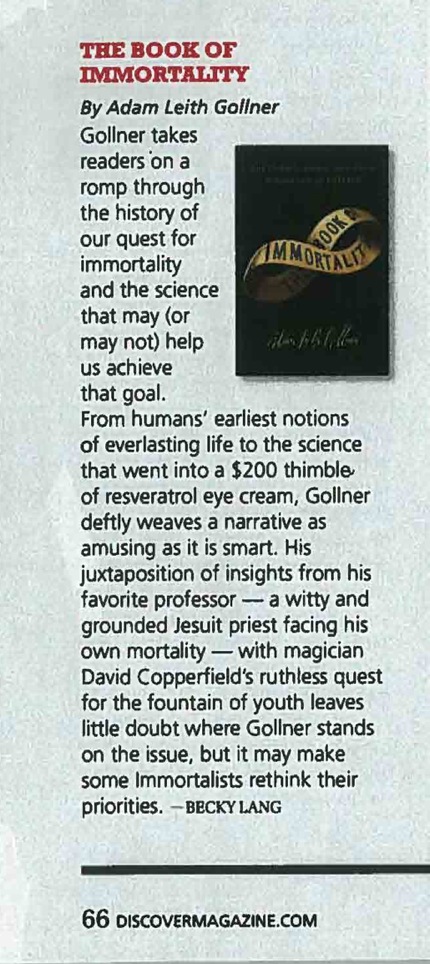
The Book of Immortality is reviewed in one of my favorite science magazines, Discover
The Globe and Mail highlights “Gollner’s meticulous eye for absurd detail” and calls the book “everything a reader could want from a non-fiction immersion in the ‘science, belief and magic behind living forever.‘”
This front-page feature by Sarah Boesveld at _The National Pos_t. offers a good overview of the book, calling it “An intensive exploration of belief in immortality, the things people do to try to claim it, the reasons they succumb to quackery, submit to mythologies, have faith in science that has never been able to stop the aging process or grant eternal life.” The Post also reviewed the book, calling it an “entertaining romp through the historical and contemporary Elysium Fields promised by science, religion and magic.” Read it here
Reader’s Digest Canada made the book an editor’s choice, alongside running a 15-page excerpt.
“Lively and wide-ranging… a study that strikes a perfect balance between intellectual inquiry and personal quest,” says the Montreal Gazette’s Ian McGillis. Read the full story here
“Insane,” says GQ, in their list of the 8 Things You Need To Watch, Hear, and Read This Week.
Publisher’s Weekly, who already wrote an excellent review of the book here deemed The Book of Immortality to be one of the “best new books of the week.”
Sohrab Ahmari of The Wall Street Journal also reviewed the book for NY1. “It’s this world of latter-day spiritualists, pseudo-scientists and assorted cranks that Adam Gollner explores with sharp reporting and good humor in The Book of Immortality.”
Flaunt Magazine points out that “When (and if, right?) Gollner dies, it’s going to be even more special, because he will be the guy who wrote about not-dying.”
“Gollner’s a great storyteller, and while the topic is both heavy and deep… his text slides fluidly between philosophical, folkloric, theological and scientific discourses,” explains Cult Montreal. “He depicts his subjects earnestly, refusing to merely flatten them into a parade of quacks — which is impressive.”
In conversation with Kate Tuttle at The Boston Globe about our undying belief in cheating death.
Cruising Montreal searching for the meaning of life with Emily Raine for Hazlitt
The Winnipeg Free Press points out that “Gollner’s journey is not linear; it meanders and flows, like the water often used to symbolize endless death and rebirth.” That was precisely what I hoped the narrative would do: flow “like water.”
I also had the pleasure of being interviewed by two of the great modern-day radio interviewers: Brian “The Grandmaster” Lehrer of NPR in New York, and Brent Bambury of the CBC. You can listen to them here:
Brian Lehrer
Brent BamburyLastly: Turkey!
Can somebody please bring me to Istanbul? (Just putting it out there.)
-
Live on NBC's 'Morning Joe'
Aug 23, 2013Today on MSNBC’s ‘Morning Joe’: Martin Luther King III, Dolly Parton, David Axelrod, Rev. Al Sharpton, and… THE BOOK OF IMMORTALITY!!

-
Excerpts and Other Reading Material
Aug 21, 2013The first installment of a seven-part series on the history of immortality through the ages for The Paris Review Daily
A look at the superwealthy immortality financiers for The Daily Beast
First impressions from my expedition to David Copperfield’s private island in search of the fountain of youth in Vice
Can science deliver immortality? See my piece in Salon
More on that in Forbes
If listening is more your speed, here’s a couple of in-depth NPR interviews I’ve done regarding The Book of Immortality:
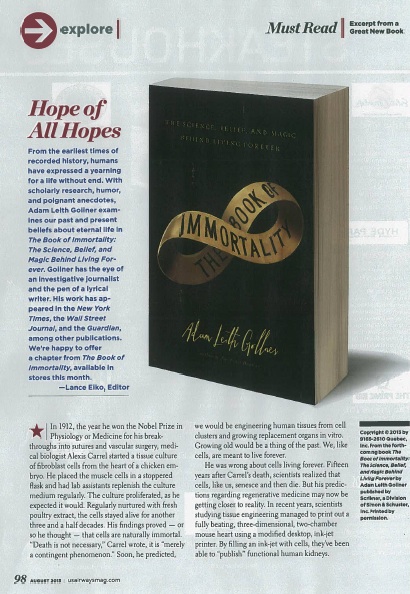
And if you happen to be flying with US Airways, be sure to check out this month’s “Must Read”
-
Book Launch!
Aug 07, 2013One of the best places in my neighborhood is a bookstore called Libraire Drawn and Quarterly. Sometimes, in the early evening, I stroll over there to see what’s new and interesting (everything is).
On the evening of August 21st, please join me for the book launch of The Book of Immortality, from 7pm – 9pm.
I will say a few words. There will be drinks. There will be laughs. There will be hugs.
Hope to see you there!
The address is 211 Rue Bernard Ouest, in Mile End, Montreal.

Thank you to everyone at Doubleday Canada, Pop Montreal and McAuslan for helping out!
There’s a poster for the event here:
TheBookofImmortality_Poster_v2.pdf -
Charting
Jul 25, 2013The Fruit Hunters Documentary hits the top 10 on iTunes!
Download it now on iTunes.
Read more here:
http://www.indiewire.com/article/top-10-documentaries-in-itunes-the-entrepreneur-gets-boost-from-news -
An Excerpt
Jul 24, 2013The introduction to The Book of Immortality is now available to read at Scribd .
(Please note that there is a prologue that comes before the intro, but to read that you’ll either need to see if it’s up on Google Books or in the “look inside” feature on Amazon, or who knows, maybe it’ll surface somewhere else.)
There’s one line in the prologue that has now been stretched into an article that will be in issue #8 of Lucky Peach magazine.
This is what my office floor looked like when I was editing the intro:

This is what I looked like when I finished editing the intro:

-
The Trades Are Glowing
Jul 23, 2013In a starred review, Publisher’s Weekly calls The Book of Immortality “an engrossing, immensely fascinating tour of beliefs and attitudes about death, presented with a relatively unbiased, if skeptical, eye. There is no one true answer provided here; in fact, there may be too many answers. As Gollner puts it, ‘We haven’t yet found certainty. We can uncertainly state that we likely never will.’ His attempt may be the next best thing.”
Read the whole review hereIn their own starred review, Booklist calls it “a probing inquiry into the most insistent of human hopes” and an “intensely personal attempt to understand mortality’s boundary.”
And Kirkus Reviews calls it “An entertaining, well-researched account of the quest that brims with our fond hopes, foolishness and even desperation.”